Understanding Equality Operators in PHP: === vs. ==
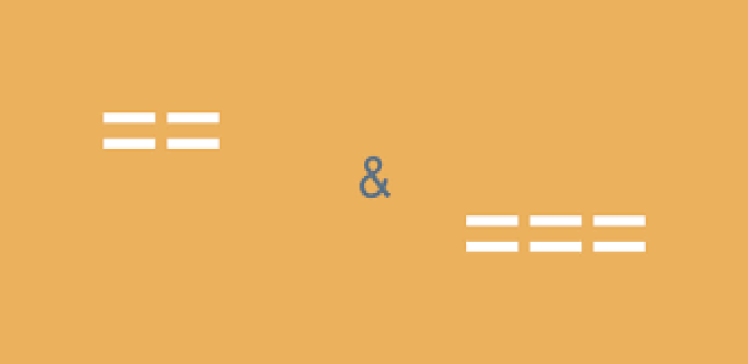
Equality operators are fundamental in programming, allowing us to compare values for various purposes. In PHP, two commonly used equality operators are === (strict equality) and == (loose equality). In this blog post, we'll explore the differences between these operators, common problems developers encounter, and how to resolve them.
Understanding === (Strict Equality)
Strict equality (===) is a comparison operator in PHP that checks both the value and data type of two variables. This means that for two variables to be considered equal with ===, they must have the same value and the same data type. Here's an example:
$a = 5;
$b = '5';
if ($a === $b) {
          echo '$a is strictly equal to $b';
} else {
          echo '$a is not strictly equal to $b';
}
In this case, $a is an integer, and $b is a string. Since their data types are different, the strict equality check returns false.
Understanding == (Loose Equality)
Loose equality (==) is another comparison operator in PHP, but it only checks the value of two variables, not their data type. This means that variables with different data types can be considered equal with == if their values are equivalent. Here's an example:
$a = 5;
$b = '5';
if ($a == $b) {
          echo '$a is loosely equal to $b';
  } else {
          echo '$a is not loosely equal to $b';
 }
In this case, $a and $b have different data types (integer and string), but the loose equality check returns true because their values are equivalent.
Common Problems with ===
- Data Type Mismatch: One common problem with
===is data type mismatch. When comparing variables with different data types using strict equality, you might get unexpected results. For example:
$a = 5;
$b = '5';
if ($a === $b) {
          echo '$a is strictly equal to $b';
} else {
          echo '$a is not strictly equal to $b';
}
Solution: To avoid this issue, ensure that the data types of the variables being compared match your expectations. If necessary, perform typecasting or data type conversion.
- Leading/Trailing Spaces: Another issue with strict equality involves leading or trailing spaces in strings. For example:
$a = 'apple';
$b = ' apple ';
if ($a === $b) {
          echo '$a is strictly equal to $b';
} else {
          echo '$a is not strictly equal to $b';
}
Solution: To handle this problem, use the trim() function to remove leading and trailing spaces from strings before comparison.
Common Problems with ==
- Type Juggling: Loose equality (
==) performs type juggling, which means PHP may attempt to convert the data types of variables to make them match. This can lead to unexpected results. For example:
$a = 5;
$b = '5';
if ($a == $b) {
          echo '$a is loosely equal to $b';
} else {
          echo '$a is not loosely equal to $b';
}
Solution: Be cautious when using loose equality, and ensure you understand how type juggling works. Consider using strict equality (===) when you want to avoid type juggling.
- Unexpected Results: Loose equality can lead to surprising outcomes when comparing different data types. For instance:
$a = '5 apples';
$b = 5;
if ($a == $b) {
          echo '$a is loosely equal to $b';
} else {
          echo '$a is not loosely equal to $b';
}
Solution: When using loose equality, be aware of the potential for unexpected results and thoroughly test your code.
Choosing the Right Operator
Selecting the appropriate equality operator depends on your specific use case:
- Use
===(strict equality) when you need to ensure both the value and data type match, and you want to avoid unexpected type conversions. - Use
==(loose equality) when you only care about the value and are willing to accept some level of type juggling.
Best Practices for Data Handling
To minimize equality operator issues:
- Ensure consistent data types in your application.
- Validate and sanitize user input to prevent unexpected data.
- Use explicit typecasting when necessary.
- Document your code's behavior with comments.
Conclusion
Understanding the differences between === and == in PHP is crucial for writing reliable and predictable code. By being aware of common problems and following best practices, you can avoid unexpected issues and make informed decisions when choosing the right equality operator for your code.
References and Further Reading
/


0 Comments
Add a comment